dnxOS
- flexible management, advanced diagnostics
- centralized configuration
- secure data transmission, role‑based access
- for industrial and enterprise infrastructure
dnxOS — Operating System for Donyx Routers.
Optimized for industrial and enterprise infrastructure, dnxOS delivers flexible management, advanced diagnostics, centralized configuration, and secure data transmission. dnxOS enables advanced device configuration management, secure network operations, network scaling and segmentation, and quality of service (QoS) assurance. It also provides integrated diagnostics and centralized infrastructure management within a unified system.
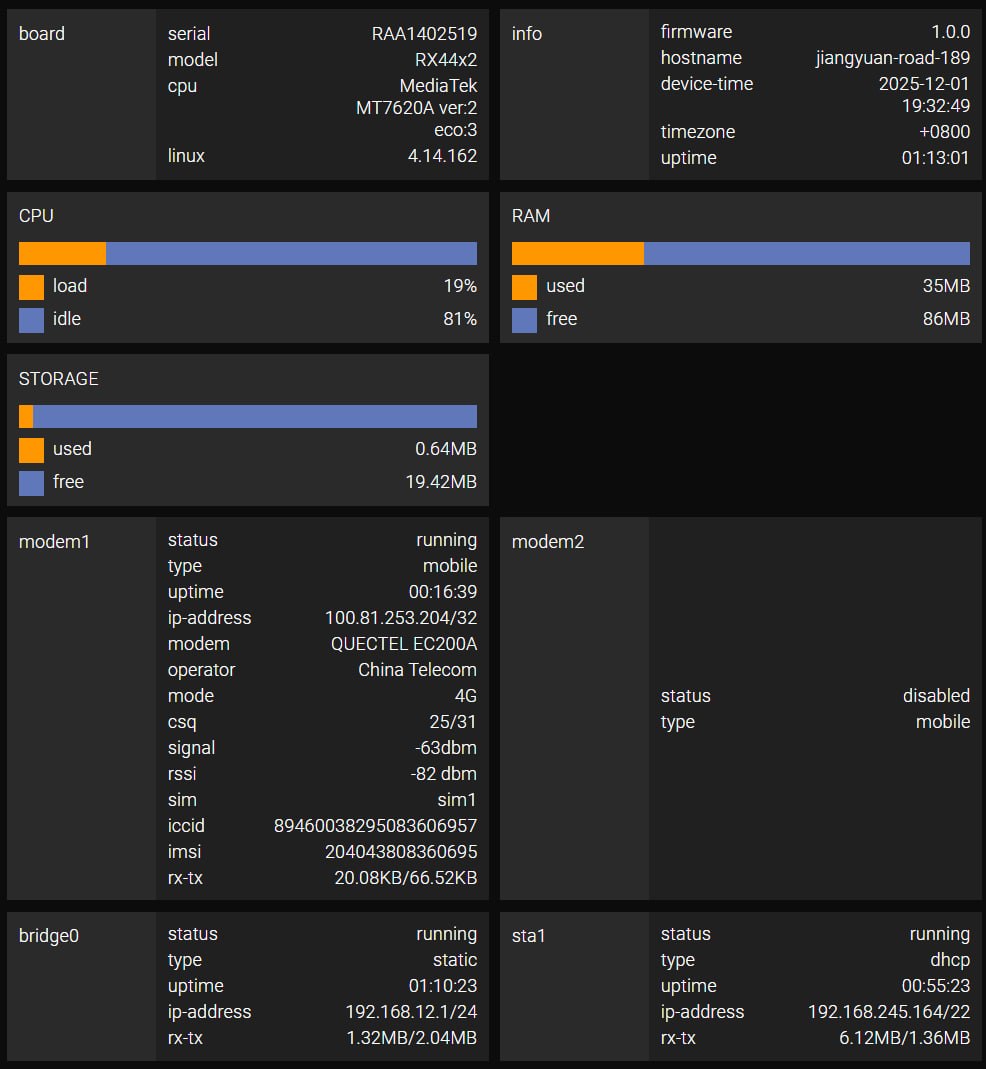
The web interface and CLI are fully synchronized, using the same logic and command structure. Unified CLI commands provide context-sensitive hints, reducing errors and eliminating the need for deep Linux knowledge. Any change made in the web UI is instantly reflected in the CLI, and vice versa, ensuring configuration integrity. Key router parameters (CPU load, memory usage, interface status) are displayed in real time on the main dashboard. A flexible user and permission system supports role-based access control for both the web UI and CLI. Granular permissions can be configured for individual sections. Custom software integration is simplified via manifest files – without manual UI layout configuration, and new sections appear instantly in both interfaces.
Advanced networking features include hardware-accelerated encryption and support for tunnels such as IPSec, GRE, OpenVPN, WireGuard, L2TP, PPTP, and EoIP. Server modes are available for L2TP, PPTP, and OpenVPN. The router configuration is stored in a human-readable text format, allowing manual editing and transfer across different Donyx device series while preserving command compatibility between software versions. Configuration changes are first applied in RAM and only saved after a successful health check; an accidental lockout can be resolved by rebooting to the last working configuration.
Wi-Fi 802.11s mesh networking provides multiple SSIDs and dynamic client segmentation. Built-in diagnostics include ping, arping, traceroute, sniffer, pinger, journal logging, GRE keepalive monitoring, SNMP polling, and Zabbix integration. QoS prioritizes VoIP, video conferencing, and latency‑sensitive applications. A built‑in certificate authority generates and manages TLS certificates without third‑party tools. dnxOS is available for x86 hardware (servers, PCs, virtual machines), supporting high‑load scenarios such as large tunnel aggregates or multi-gigabit Ethernet throughput.
dnxOS is designed for organizations that require stable, reliable, and secure network infrastructure with full operational control.
OpenVPN: Ability to run one server and multiple clients simultaneously.
Encryption: Client – AES-128-CBC, AES-192-CBC, AES-256-CBC; Server – AES-128-CBC, AES-128-GCM, AES-192-CBC, AES-192-GCM, AES-256-CBC, AES-256-GCM
IPsec: IKEv1, IKEv2.
Encryption: Client – AES-128, AES-192, AES-256; Server – AES-128, AES-128, AES-192, AES-192, AES-256, AES-256
GRE: GRE TUN (Layer 3)
EoIP: MikroTik RouterOS protocol based on GRE RFC 1701
PPTP, L2TP: Server and Client mode support for L2TPv2, L2TPv3
Wireguard: WireGuard tunnels and peers
DMVPN: Client mode operation, additional IP Security encryption
Routing: Static
Network protocols: PPP, PPPoE, DHCP, TCP, UDP, ARP, IPv4, ICMP, HTTP, HTTPS, TLS, SSL
Connection Monitoring: Ping Reboot, Periodic Reboot, LCP and ICMP for link tracking
Firewall: Port forwarding, ZONE-based rules, pre-configured firewall rules, custom rules, NAT
DHCP: Static and dynamic IP address allocation
Network Backup: VRRP; Wired, Mobile or WiFi WAN. Supports automatic failover to an alternative connection (Automatic Failover)
Network Services: DHCP Server, NTP, DNS, SSH, SNMP
Authentication: Pre-shared key, digital certificates, X.509 certificates
Attack prevention: DDOS prevention (SYN flood protection, SSH attack prevention, HTTP/HTTPS attack prevention), port scan prevention (SYN-FIN, SYN-RST, X-mas, NULL flags, FIN scan attacks)
VLAN: Port and tag based VLAN separation
Access control: WiFi access control (MAC address filter)
UI: WEB UI access via HTTP/HTTPS, CLI access via SSH, status, setup and configuration, firmware update, system log
SSH: SSH (v1, v2)
SNMP: SNMP (v2c, v3)
Zabbix: Zabbix Agent (requires manual package installation)
Wireless mode: Access Point (AP), Station (STA), Station Bridge (STA WDS mode allows interface to be bridged)
Wi-Fi security:
- WPA/WPA2-Enterprise-PEAP, WPA/WPA2-PSK, AES-CCMP, TKIP, Auto Cipher modes
- SAE
Wi-Fi users: Up to 100 simultaneous connections
SSID: SSID stealth mode, access control list MAC address